
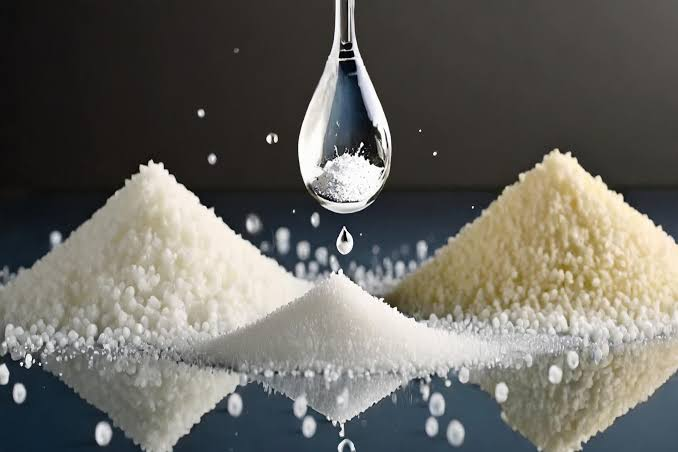
How Protein Powders Are Processed for Better Flow and Solubility
Protein powder may look like a simple product, but producing a powder that performs well in a scoop, filling machine, shaker bottle, or glass of water requires careful control of its physical properties.
Whey, milk, soy, pea, and other protein powders can contain very fine particles that tend to stick together. This affects flow during manufacturing and creates familiar problems for consumers: powder floating on water, forming lumps, sticking to the scoop, or requiring prolonged shaking.
Modern protein powder processing therefore focuses on more than protein content. Particle size, moisture, porosity, density, surface properties, and agglomeration all influence how the final powder handles and reconstitutes.
Fine Particles Create Handling Problems
Smaller particles provide a large surface area, but extremely fine protein powders can become highly cohesive.
Interparticle forces become more significant as particle size decreases. Instead of flowing independently, fine particles tend to stick together. This can result in bridging inside hoppers, inconsistent feeding, dust generation, and difficulties during weighing and packaging.
These characteristics matter throughout production.
A powder that flows inconsistently can affect dosing accuracy and filling speed even when its nutritional composition is exactly within specification.
Particle engineering is therefore an important part of commercial protein powder production.
Good Solubility Starts With Good Wettability
Solubility and wettability are closely related but should not be treated as the same property.
Before protein can dissolve, water first needs to contact the particle surface. Fine protein powders may remain on the liquid surface or form clusters when they are added to water.
Once the outside of a cluster becomes wet, it can form a barrier around dry powder trapped inside. This produces the stubborn lumps commonly seen when some protein powders are mixed.
A well-designed instant protein powder needs to wet, sink, disperse, and finally dissolve.
| Powder Property | Effect on Processing or Reconstitution |
| Particle size | Influences flow and wetting |
| Porosity | Helps water penetrate particles |
| Surface properties | Affect initial water contact |
| Moisture | Influences stability and stickiness |
| Bulk density | Affects packaging and dosing |
| Agglomeration | Can improve flow and dispersion |
Improving consumer experience therefore requires control over the physical structure of the powder rather than simply reducing particle size.
Drying Conditions Influence the Original Powder Structure
Many protein ingredients begin as liquid concentrates that must be converted into stable powders.
During spray drying, liquid is atomized into small droplets and contacted with heated air. Rapid moisture evaporation produces dry particles that can then be collected for further processing.
Atomization conditions, feed concentration, viscosity, air temperature, and drying rate all influence the resulting powder.
Producing excessive fines can create downstream handling and reconstitution problems. At the same time, particles must be dried sufficiently to maintain stability without unnecessary thermal exposure.
The objective is a consistent starting powder that can be processed into the required final particle structure.
Agglomeration Turns Fines Into More Functional Particles
One of the most important steps in producing instant protein powders is agglomeration.
Instead of leaving the powder as a collection of very small individual particles, controlled agglomeration joins smaller particles into larger structures.
These agglomerates are deliberately different from hard, compact granules. Good instant agglomerates usually contain pores and internal spaces that allow water to penetrate.
A simplified process can be represented as:
Fine Protein Powder → Controlled Wetting → Particle Collision → Agglomeration → Drying → Cooling
As particle size increases, the powder can become less cohesive and easier to handle. The porous structure can also provide pathways for water to enter the agglomerate during reconstitution.
The result is a powder designed around both industrial handling and consumer use.
Porosity Matters as Much as Particle Size
Larger particles alone do not guarantee better instant properties.
A dense granule may actually take longer to dissolve because water cannot easily reach its interior. A porous agglomerate of similar size can behave very differently.
Water enters the spaces between the smaller particles making up the agglomerate. This increases contact between the liquid and protein surfaces, supporting faster wetting and dispersion.
The goal is therefore not simply to manufacture the largest possible particles.
Protein powder processors need a controlled balance between particle size, mechanical strength, porosity, bulk density, and dissolution behavior.
Fluid Bed Processing Helps Control Agglomeration
A fluid bed dryer can play an important role in producing powders with improved handling and instant characteristics.
During fluid bed processing, upward airflow keeps suitable particles in a mobile or fluidized state. A controlled amount of liquid can be introduced to create temporary bridges between particles. As particles collide, they begin forming agglomerates.
Continued drying removes the added moisture and helps stabilize the new particle structure.
Fluidized-bed agglomeration has been studied with whey, milk, and soy protein systems, where increasing particle size and creating more porous structures can improve flowability and wettability.
The process needs careful control because excessive liquid addition can create oversized or sticky agglomerates, while insufficient wetting may produce weak particles that break apart during conveying and packaging.
Air velocity, temperature, moisture addition, residence time, and starting particle properties therefore need to work together.
Moisture Control Prevents New Flow Problems
Agglomeration often introduces moisture intentionally, but that moisture must subsequently be removed to an appropriate final level.
Excess residual moisture can increase stickiness and encourage caking during storage. Protein powders may also absorb moisture from humid air after processing.
Over-drying is not automatically beneficial. Unnecessary heat exposure consumes additional energy and may affect heat-sensitive ingredients included in the formulation.
Final drying and cooling should stabilize the powder without damaging the structure created during agglomeration.
Formulation Also Changes Powder Behavior
Processing conditions cannot be separated from formulation.
Whey protein concentrate, whey protein isolate, milk protein, soy protein, and plant proteins do not necessarily behave the same way during wetting and agglomeration.
Additional ingredients can further change powder behavior.
Commercial protein formulations may contain carbohydrates, flavors, cocoa, vitamins, minerals, sweeteners, fats, and other functional ingredients. Some instant products also use lecithin or other ingredients to improve wetting and dispersion.
This means processing parameters that work well for one protein formulation cannot automatically be transferred to another.
Flowability Matters Beyond Consumer Convenience
Better powder flow has practical benefits throughout the factory.
Free-flowing powders move more consistently through hoppers, feeders, conveyors, and packaging equipment. Reduced cohesiveness can help limit bridging and inconsistent discharge, while controlling fines can reduce dust during handling.
This is why powder processing equipment needs to be selected around actual material characteristics.
Vortech Machine provides industrial drying and powder-processing equipment, including fluid bed systems for powders and granules. Its fluid bed equipment can be configured around factors such as material properties, moisture requirements, airflow, temperature, and residence time.
For food processors, these parameters directly influence whether the equipment can achieve stable drying while maintaining the particle characteristics required by the finished product.
Better Protein Powder Is Built Around Particle Performance
A successful protein powder needs to perform at several stages of its life.
It must flow reliably during manufacturing, remain stable during storage, dispense consistently during packaging, and reconstitute easily when the consumer adds it to water or milk.
Achieving these properties requires more than simply producing a dry, fine powder.
Particle size distribution, porosity, agglomeration, moisture, formulation, and surface characteristics all need to be considered together.
When these factors are properly controlled, protein powder becomes easier to manufacture and easier to use—flowing more consistently through production equipment while wetting, dispersing, and dissolving more effectively in the final drink.